

Exclusive Interview With Directors Steph Ching and Ellen Martinez
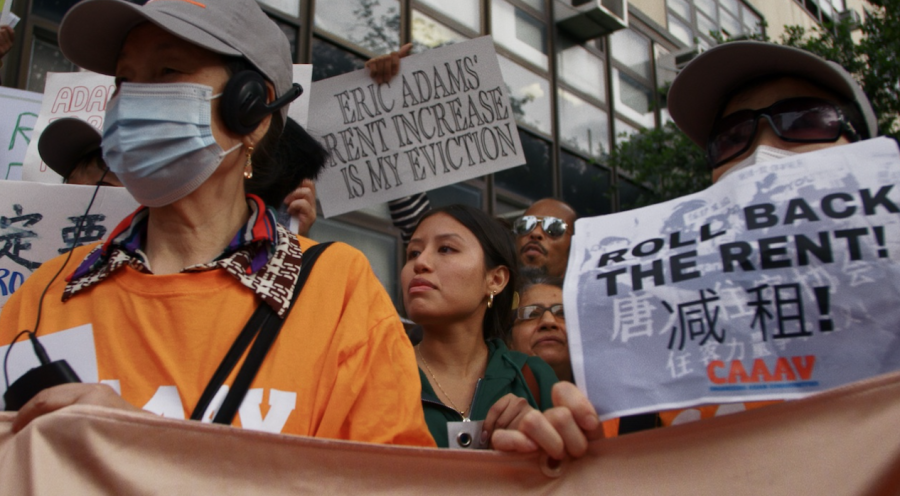
Image Via Slumlord Millionaire
Across the country, the cost of living is increasing exponentially. Forbes reported that the cost of living is a “prominent” concern among American citizens, “with surveys showing that Americans rank inflation as one of the top problems facing the country.”
New York City remains the most expensive city in the U.S. and the second most expensive city in the world, behind only Monaco. Although the average New Yorker’s salary is around $78,000, many residents live well below this rate and struggle to make ends meet.
In addition to inadequate wages, many New Yorkers, especially people of color, deal with predatory practices from landlords and a lack of consideration from the Rent Guidelines Board (RGB), who continue to raise rents, even in stabilized buildings that are meant to provide housing for low-income tenants.
This is the subject of Slumlord Millionaire, a new documentary from filmmakers Steph Ching and Ellen Martinez. The two made their collaborative directorial debut with After Spring in 2016, which follows the Syrian refugee crisis. The film was executive produced by Jon Stewart of The Daily Show.
With a world premiere at the 2024 DOC NYC festival, a limited theatrical run at the iconic DCTV Firehouse Cinema, Slumlord Millionaire has garnered praise and attention for its unflinching look into the volatility of the New York City housing market. The film premieres on the PBS series VOCES on Monday, July 28, on PBS, PBS.org, the PBS app, and will be available to rent or buy on Prime Video, Apple TV, and Xfinity Comcast on Tuesday, July 29.
“We’ve been [in New York City], you know, close to 20 years. Both of us, and my family’s actually been here since the 60s, so we’ve seen the transformation that all of our neighborhoods have gone through over the years,” said Steph Ching, exclusively speaking to Pop Culture Press.
The two set out to make a film about tenants’ rights and to inform renters about the influence they have and the impact they can make in their local communities. From there, Ching and Martinez met many of the interviewees the film features and were committed to telling their harrowing stories.
“We started with the Bravo family through Neighbors Helping Neighbors, which is an organization that kind of helped attach them to the lawyers in the film,” Ellen Martinez said. “Immediately we knew, if they wanted to be in the film, we definitely wanted to follow their story and show their fight over 15 years and their win, and actually getting justice against the landlord.”
The film depicts the Bravo family, a Hispanic family in Sunset Park in Brooklyn, fighting for safe conditions against their racist landlord who actively refused repairs and to remove mold in their apartment. When their children developed severe asthma, they helped pass the “Asthma Free Housing Act.” This requires landlords to eradicate mold in homes where children are present.
Throughout the film, the Bravo family’s bravery and perseverance are inspiring to behold, but also instill a devastating feeling that many families have to consistently advocate to live safely and comfortably in their own homes. Their plea to the Rent Guidelines Board during their public meeting is both angering and invigorating.
The film also directly addresses gentrification, which is defined as a neighborhood, usually home to lower-income residents, being changed by an influx of wealthier tenants. This actively erases the culture and community harbored in these areas and is profusely disrespectful to the livelihoods and legacies of the people who’ve occupied a space for so many years.
The efforts of the CAAAV organization are followed in the film, as a group of residents who have lived in historic Chinatown for generations protest the building of large luxury towers that will compel landlords to expedite the process of forcing out tenants.
Ching and Martinez articulately put voices on display that speak about the systemic bias against immigrants and people of color. “[People] don’t really think about the root of the problem, which is that the system is built in a certain way to oppress certain people, to prevent certain people from having agency and ownership and safety,” Ching said.
Aside from more explicitly aggressive tactics, the engaging doc also illustrates the manipulation developers employ to deceive people out of their homes. Former ‘90s supermodel Janina Davis dreamed of turning the backlot of her Brooklyn building into more affordable housing. Unfortunately, she was involved in a malicious deed theft scam.
“We were actually at a housing rally, and there was a rally for a family that was losing their home, and Janina spoke, and we thought that this is something that really everyone should know about. It’s almost unbelievable the different tactics that these developers use to steal people’s homes.” Martinez said.
The film does an excellent job of elucidating the horrific actions committed by people in power who use their resources to deplete the lives of marginalized communities for their own benefit. Deed theft especially affects Black and Brown neighborhoods and specifically targets property owners of color to take away ownership and prosperity.
Politics is also a crucial part of the conversation in Slumlord Millionaire. Bangladeshi-American activist Moumita Ahmed chronicles her 2021 New York City Council campaign in which she actively spoke out against tenant harassment after growing up housing insecure.
Though she gained the support of notable figures like former presidential candidate Bernie Sanders, she was also seen as a threat by developers and real estate agents who wanted to populate New York City with more luxury apartments. The film notes multiple offensive and exaggerated attack ads paid for by these developers that plagued Moumita’s campaign and others who were pro-tenant rights.
Moumita ultimately lost the campaign, but has not ceased her fight in defending those who’ve been victims of housing abuse. Ching and Martinez made an effort to specifically comment on how money influences politics and entwines with what kinds of issues are the most pressing. “We just saw what was happening and how the money in politics is so much a part of the housing system in the city,” Martinez noted.
All of these intersecting stories coalesce to illustrate a larger problem that deeply affects so many people, whose lives are often at stake. The film pivots between more uplifting moments that evoke triumph and joy within audiences and also devastating realities that are meant to showcase what is at stake.
Economic issues are ubiquitous and affect all facets of everyday living, but housing remains a crucial necessity that is unfortunately not guaranteed. Even when provisions are put in place to protect renters and property owners, loopholes are exploited to undermine individual power and autonomy.
“I think it’s extremely urgent,” Martinez said. “It felt urgent when we started the film, and it’s getting even more urgent.” This urgency inspires, more than ever, a collective organizing of local communities to come together and work towards positive change, making affordable housing a necessity rather than a privilege.
For more information on this pressing issue, visit:
https://www.instagram.com/housingjustice4all/
https://www.instagram.com/caaavnyc/
https://www.instagram.com/caaavvoice/
https://www.instagram.com/nhn_bk/
https://www.instagram.com/fifthavenuecommittee/
https://www.instagram.com/fifthavenuecommittee/