
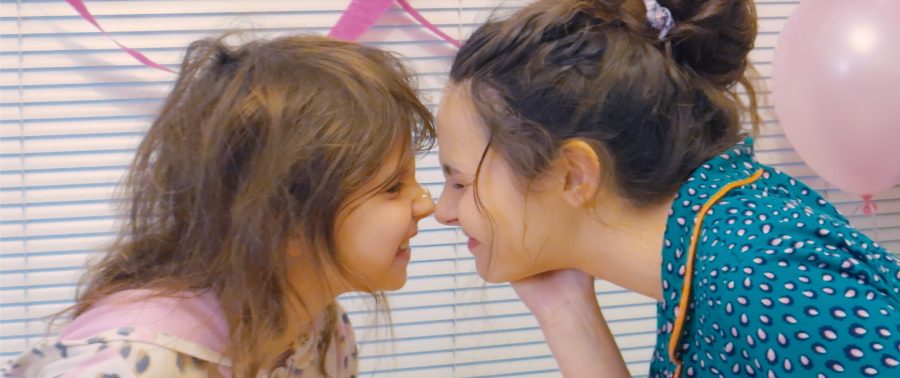
It’s not uncommon that when one member of a family displays a passion for the arts, others express a similar interest. Show business families have been responsible for some of the most iconic films, television shows, and music, proving that collaboration is sometimes the most effective when working with people one grew up with. Though the new family drama What Tomorrow Brings is only the Engelbert family’s first feature film, they understand this dynamic completely. The film was directed by father Matt Engelbert, starring his daughters Joely and Phoebe in the lead roles. In addition, his other daughters Ariel and Zoey play supporting roles, while his wife and son have off-camera roles in both the cast and crew.
Filmed entirely on the iPhone 15 Pro Max, What Tomorrow Brings demonstrates a tremendous amount of love and bravery in its screenplay, as two sisters face a horrific situation, having only each other. The film had its world premiere at the Santa Fe Film Festival, where Joely Engelbert won Best Actress and has received praise for the emotionally compelling chemistry between real-life sisters. What Tomorrow Brings is available on TVOD/AVOD on September 4, 2026.
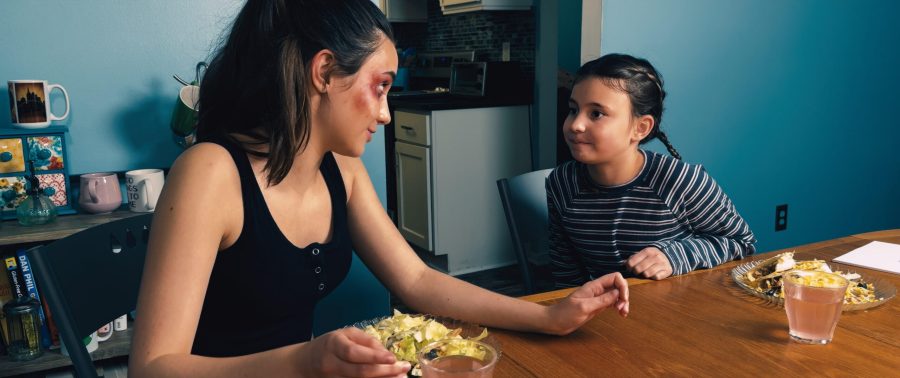 Joely and Phoebe Engelbert in What Tomorrow Brings
Q. How was the process of bringing the whole family together to make this film?
A. Matt: Well, it was important for me. I wanted to make this film surrounded by my family, who I knew had the talents to pull it off. For me personally, it was an important project. I love the story, but I also knew that I had the resources with the family. It’s a massive undertaking, making a feature film, and I don’t know what that budget would look like if I were doing something on a different scale where I’m bringing in different people.
Joely and Phoebe both have wonderful experience in acting, so I thought it was an interesting opportunity to let them have those roles and be in that position. Eli, their older brother, handled the sound and the soundtrack, and I knew I could rely on him for that. Then the older siblings, Ariel and Zoey, I knew that they could handle some of the roles within the film. Zoey was the bass player, and Ariel was the teacher. It was the right time for both Joely and Phoebe to handle a much larger role.
Joely: I’d been auditioning for lead and supporting lead roles since I was 12-years-old, and then finally I got close to getting this one role, and it was between me and this other girl who was 18, and they went with the 18-year-old, and I just had enough. I was like, “Dad, we need to make a film. I don’t care how long it takes. We need to make a film.”
Matt: Yeah, and I had that story idea for a long time. I had lived through part of that story, not directly but with close friends, and was haunted by the idea of what would happen if there was nobody there for the children, but I had to change the ages of the children up considerably for the purposes of the story.
Q. Matt, what is it like being a parent as well as a filmmaker and being in a family of actors? How does your family support each other through their passion for art?
A. Matt: I’m sort of grounded in reality. I know that sometimes life can really suck; it’s not easy, and reality is not easy. We can try and protect as much as we can, but [Joely] lived through it. Both she and Phoebe would live through these rejections, and they went through callbacks and final callbacks and going to New York and going back home. It’s part of the process. It’s just a chapter in your story, and you can decide when that story ends. You don’t have to do this. There are many other things you can do in life that can be very fulfilling and won’t require constant rejection. I mean, you do really set yourself up. You have to have a thick skin for this, so I’m there to support them, but I don’t like giving false praise.
So, with this movie, if they weren’t up to the task, this movie would be really bad. I mean, some people might think the movie is bad, and that’s ok, but it wasn’t because of the acting. In this particular situation with these characters, and in particular Joely’s character, who’s in 99% of the scenes because it’s told through her lens, if she wasn’t up for that type of role, to have that level of acting, then that really would’ve been on me, and that would’ve poorly reflected on me as a parent too. I don’t think it’s a great idea to set your kids up for failure or say, “Oh, here’s something you can do. You can have your name on something.” But it was also really enjoyable for me as a parent because I really enjoy working with my kids and being around them.
Q. How was it decided that the film would be shot entirely on iPhone 15 Pro Max?
A. Matt: Well, again, it’s a feature film, and you’re looking at a budget, and I didn’t want to be cheap about it. I knew I wanted to handle the camera. That’s something that I really enjoy doing, but I knew I’d also be doing the directing of this as well, and when the iPhone 15 Pro came out, and I used the Pro Max, it was the first time that with an Apple phone you could shoot in log. That intrigued me. My son, Eli, was really against it, and I said, “Well, let’s film one scene, and we’ll put it on your computer, and we’ll see what you think.” The very first scene that we shot was actually the bedroom scene, the evening of Ruby’s birthday. That was the very first shot. And we looked at it, and we thought, “You know what, that works.”
I didn’t find any issues using the iPhone either. I also used, from Beatsgrip, one of their anamorphic [lenses], their 1.33 anamorphic lens, and I just liked the way it looked. So, after that first scene, I decided to get two more iPhone Pro Max [phones] and have those for various scenes we shot. As I think you can tell, shot from beginning to end, there are no cuts between any [shots]. So, once the actors really found a rhythm, we found the take that we were satisfied with, and then we moved on. But just being able to set up one, two, or three iPhones was a lot easier than the alternative.
Q. How did you balance the sweet, wholesome tone of the film with the darker scenes?
A. Matt: So the way that the writing process worked was, I had the story, and I wrote the story, then I wrote the script, but then I brought both Joely and Phoebe into the screenwriting aspect because I wanted the words to be their words. It’s interesting because sometimes I’ll read some critics’ [reviews], and they’ll be like, “Kids would never say that,” and I’m like, “They wrote it.” (Laughs). Don’t blame me. It wasn’t a 58-year-old guy writing that for them. It was actually them talking. I’m also a dad, and when I’m writing that story, I did start going sometimes in different directions, and the emotions would take hold.
I wanted to go a certain way, but I just couldn’t do any more to Clara. I knew the audience, watching this film, the first ⅔ of it, might even get frustrated with Clara. They might be like, “Why don’t you do this? Why don’t you do that? Why are you acting the way you’re acting?” I also knew that for the role of Ruby, the audience had to really connect and just love Ruby.
She couldn’t be just like a cutesy [kid]. She had to be a real kid, and someone you would care about. So, there was that balance, but then there’s a certain point in the film-I think you know what I’m talking about-that darkest moment. I had to pivot, and how much do you pivot? Do you pivot too far? Do you not pivot enough? I just couldn’t do anything more to hurt Clara, as a writer.
It could’ve continued that way, but that’s how I chose to balance it. Being a dad, there were some instincts that kicked in as to why I made some of those choices, especially in that final third of the movie.
Joely: I think I was in the same mental space the entire time with the movie.
Matt: That’s true. It did take a long time for her to get out of that role, to recover from the role, because she really was living with that character for perhaps too long. I mean, Clara is a lovely human being, I mean, an incredibly strong human being, but I think that’s a lot to live with.
Joely: Yeah, and also, like, when you’re 16 or 17, it’s hard to, like, get out of that mental headspace and get out of that character. Which now, like, as an almost 20-year-old, I can get out of character, but when you’re constantly just in that role, you start to morph into that character, and I think that’s kind of what happened.
Q. What were the most fun moments on set? Did being a family make the shoot more fun? More challenging?
A. Joely: I think it made it more fun honestly. I mean, obviously it was like three years ago when I filmed this, almost four. But I remember having fun getting my black eye, like in the makeup chair.
Matt: Yeah, Zoey was doing the makeup. Everything about it felt like a family. The people that I brought in to be the other actors were people that we’d known for many years and that we loved being around. That was something very important to me too. I wanted this to be, even though it is a very dark film, I wanted it to be a fun experience. When we were around the other people, whether we were flying them in from New York or they lived closer to where we lived back then in Michigan and Ann Arbor, it really was fun. Everybody knew each other. The Thanksgiving scene, everybody was together.
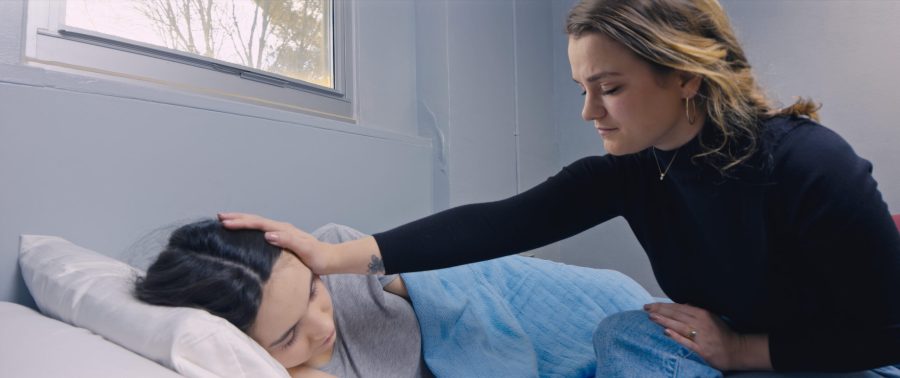 Joely Engelbert and Grace Bydalek in What Tomorrow Brings
Joely: My mom made that whole dinner. It was really good, and she was like, “Ok we’re gonna split it in half.” That’s what we thought, so we ate all of it, and everyone was waiting in the back for their food, and they were like, “You ate it all.” (Laughs).
Matt: (Laughs) Yeah, I didn’t realize she had put everything on those plates, and so it was like, “Cut, cut, cut! You guys are done eating.” Caroline, my wife, did those types of things, like cooking the turkey. She also did several things with the wardrobe. She’s also the voice of Dr. McAdams, which I chose to be off camera, not because she could be off camera; she’d be beautiful on camera, but she was sitting at a table. I had to reuse people for those scenes.
The diner scenes and the restaurant scenes. But shooting as a family, there were a lot of things that were quite fun about it, but there were a lot of scenes. I don’t want to give anything away, but the scene in the tent. I made sure that Phoebe was able to watch the makeup being applied so that Phoebe wouldn’t be upset when we were shooting that particular scene. Of course, she got to close her eyes.
Joely: She was sleeping (laughs).
Q. Joely, your singing is featured prominently in the film. Talk about what that scene meant to you and how you prepared for it.
A. Joely: Yeah, so my sister Zoey, she wrote that song, and that was the very last scene that we filmed. That was the last shooting day. And it didn’t quite click in my head until [dad] was like, “This is your last performance, feel it,” and I was recording, and I was like, “Wait, I’m sad.” But it was also very freeing cause I was like, “I’m finished! I can let Clara be now. She can go. I don’t need to be her anymore.” I mean, it was like, bittersweet. I miss that role, but I was very happy to be myself again.