
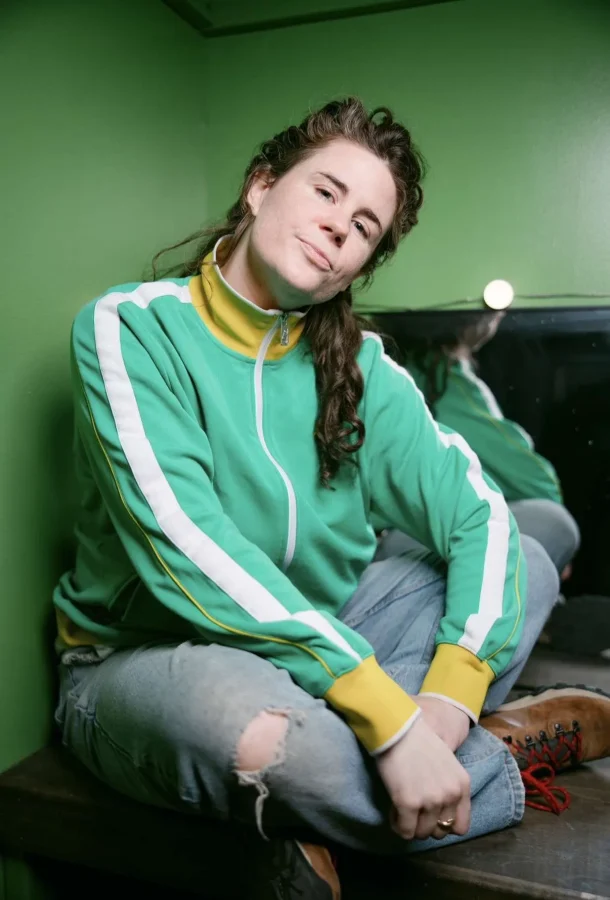
An Exclusive Interview with Writer/Director Lindsay Calleran
A director’s first feature film is one of the most represenative of their career. It is a multi-facated culmination of the experience the artist has gained, what they have yet to explore, and where their film journey might take them. For independent filmmaker Lindsay Calleran, the feature debut reflects this and so much more. Her latest film, Caity, which had its world premiere at the Village East by Angelika theater in Lower Manhattan at the 2026 Tribeca FIlm Festival, showcases a true commitment to not just the art of film, but the dissection and display of pure human emotion.
The film follows the relationship between the 16-year-old self-titled protagonist, her newly sober father, her coworkers at her family’s Haunted House attraction, and a new crush, beautifully weaving together a story of love, desperation, and discovery. Centering most of her work around addiction and how it effects a family, Calleran effortlessly dives into this world with vivid camerawork, passionate writing, and stunning performances from the female and male leads, Chiara Aureila and Morgan Spector.
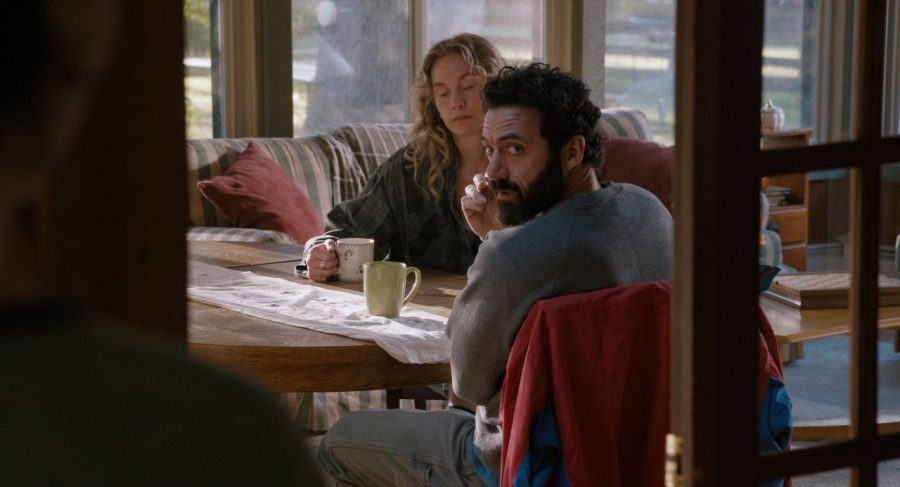 Morgan Spector and Emily Shaffer in Caity
Q. How did it feel to receive a standing ovation when you were introduced at the Caity premiere before the film was even screened?
A. Yeah, it felt really surreal. I think, more than anything, I felt a lot of gratitude. What I felt in that moment was all the friends and family who are familiar with the film cheering for the fact that we had done it at all, and that we were here, because it was an extremely long journey with so many ups and downs. The project fell apart several times, and it required just a lot of perseverance and a kind of dogged refusal to accept failure in order to get it made.
What I felt in that moment was a celebration of the persistence of an artist. I would love to be like “oh yeah they just preemptively know that the film is incredible,” but none of them had seen the film so the standing ovation I think more represented just like a community celebrating the achievement, especially after such a long journey, which was amazing.
Q. What were some of the biggest challenges during filming and how did you work closely with your cast and crew to overcome them?
A. There were so many challenges, because for years I tried to get this project made in so many different iterations. [It] just never got to the start line, if the start line is day one of production, and so I ended up making this movie with two dear friends. We had made short films together, [the producers] so, at the end of the day, I was like, I’ve made so many short films, I believe in my ability to execute that type of production, so I am going to work with the people I trust, who I’ve made a lot of short films together with, and we’re going to basically make this feature in the same fashion that we made the short, but it’s going to be a lot longer.
But I trusted them, and that ended up being useful so many times for so many reasons, because it is so hard, and the three of us, I’m talking about Mary Elizabeth Monda and Malcolm Thorndike Nicholson, the three of us, every day had to put out massive fires. If not for the belief that we all had, and the desire, the individual desire, I think it would have maybe knocked us over. But we made it through every day. It was just an unbelievably short timeline. I mean, we shot the movie in 18 days. Our principal photography was 18 days over 3 weeks, so the days were extremely packed.
We were learning as we went about how many needs there were, and we were adapting every day to make sure our crew was supported, that our cast was supported. We were adding resources as we went. We were in some ways catching up to ourselves as we went, but I think having the core, shared desire and trust, which I think is really unusual in independent film, allowed us to always rise to the occasion.
Q. Talk about the pipeline of going from directing short films to features and how it has changed your perspective as an artist.
A. The actual execution in some ways is very similar at this level, at the independent film level, where you are still a very tight-knit team, you’re still very insulated, and you’re still making something that is yours. A feature changes to be a much bigger infrastructure and ecosystem, but this was still very small. I was working with the same editor and director of photography, Joe Sankis and Jack Davis, who I had made all my short films with, and a lot of the same crew. We’ve all known each other for about 10 years. We went to grad school together and made stuff together so in some ways the execution was very similar, just much longer.
It was, like, suddenly running a marathon versus a 5K. But the process of getting from one step to the next, and from making short films to making a feature, it’s just extremely difficult if you don’t have access points and resources that some other folks are able to have, especially financial. It requires so many years of trying to apply to labs, to get institutional support, get connected to different people, and pitch your project. In a short film, you really can make a short film nowadays for almost nothing.
It’s much easier to save, you know, $5,000 or $10,000 and make a short. It’s easier to crowdfund your short, but it’s just not possible with the feature. You know, you need other people to allow you to do it, so it requires a really intense amount of persistence. Certainly on Caity, it did.
Q. At the film’s heart is the relationship between Caity and her dad, and the film was dedicated to your own father. Talk about how your real-life experiences influenced the film.
A. Yeah, I have a really long creative history with my dad, who was an artist in many different respects, and we had a very collaborative life together. He was in many ways, the center of my creative inspiration for so long and then he passed very unexpectedly, in the middle of development, or really towards the end of development. He was in very close proximity to the film, he had read the script, he knew about it intimately. We were casting already at that point, he had seen all the casting tapes, and was very involved in the whole process. I didn’t know I was gonna dedicate the film to him until the very end, but at that point, it just felt sort of inevitable.
The film itself was always so much about him and my relationship to him, but the process of making the film became so guided by the loss, and, it felt just, inextricably, connected. My editor and I spoke a lot about how personal the film is and, how in some ways perhaps it’s better to just lean into that or be explicit about it rather than be implicit because it has such a personal DNA. I think people feel that all the time when they watch it, regardless of whether I had dedicated it to my dad at all. It was almost like, you know, there’s no need to be coy. We can kind of just say it how it is.
The personal thematics are very much from my own life. I’ve spent many years thinking about the way that addiction impacts a family, and the family system, and I had really just wanted to go back and show a portrait of a family dealing with addiction from the youngest member of the family who maybe has the least understanding, because that was my own experience.
There are maybe reasons why that’s not the most popular narrator for a story like that, the person with the most confusion, least information, and the youngest, but at the same time, I’m sure it’s relatable to a lot of people, who’ve dealt with family dysfunction. We all go through a phase where we’re really unsure of what’s going on with our parents, but we can tell that something bad is happening, but we don’t really get it, and that was what I wanted to explore with Caity.
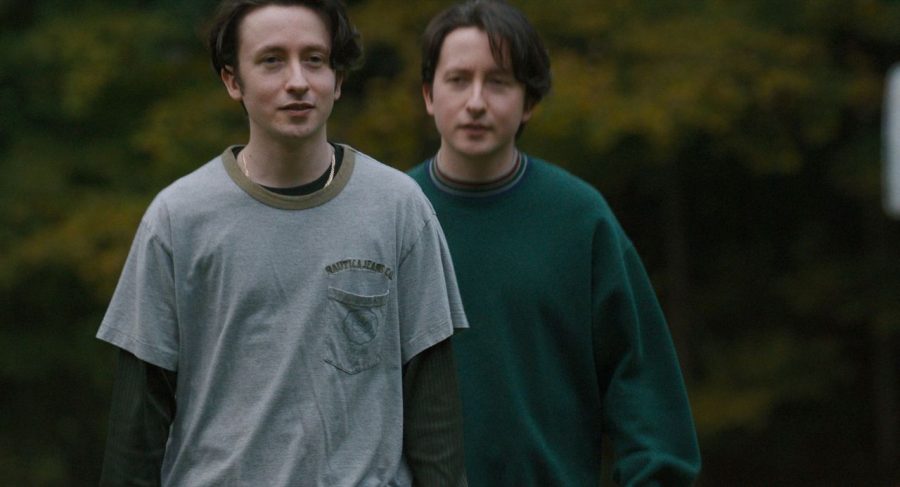
Christian Lees and Jonah Lees in Caity
Q. Your portrayal of teenagehood in this film is deeply effective and will likely resonate a lot with viewers. Talk about how you paid careful attention to these character dynamics when writing the film.
A. I really dug into my own experience of being a teenager and tried to isolate the feelings that I felt and kind of build out the world around the feelings. I have very strong memories of feelings that I felt when I was that age, but I didn’t know necessarily that they would be that relatable, but I wanted to just be as specific as possible. I think being a young person, being in the midst of a lot of familial confusion and insecurity and at the same time, having a complicated understanding of your own sexuality, and being very terrified of the vulnerability it takes to explore your sexuality, or your romantic side, even.
That was true for my experience, and I’ve found in my life that it also seems to be true for a lot of people, in a lot of different situations, but certainly people that grew up in family dysfunction. I think there’s such a priority given to what’s going on in the family and such an insecurity around the family that that can carry over into the insecurity of your own identity. That was what I was working with with Caity, trying to show how what’s going on with her family, and particularly her dad, is subtly but explicitly impacting what’s going on with her self-discovery.
Q. Talk about how your position as the writer/director helped you see the film all the way through from the early drafts of the script to the final edit.
A. So far, that is the only version that I’m familiar with, although I would love to direct more things that I didn’t write, and maybe vice versa. So many of my favorite films are by writer/directors, and my theory that I’m coming up with at the moment is that, there is an even deeper creative expression happening. I love when art is one artist’s very earnest attempt to express something specific to them. I think that that is a beautiful gift, whatever the art form is.
I think with film, when it is both a writer and a director, you’re getting a really deep insight into what that person is trying to express creatively. All the way through, from the origins of the story, and the characters, and the setting, and the places, to how they use the camera. How do they have the camera interact with the subject? How does the edit feel? What is the soundscape?
All of these things are, like, one person’s earnest attempt to really show you something and that’s not to say that that’s not also true in projects where there’s a separate writer or a separate director, but, I think it’s unique to writer/directors. There’s something, I think, a little bit different, more personal. I feel extraordinarily lucky that I was able to direct the script I had written and then work so intimately with the editor in post and the sound designer. So it really felt just like trying to explore this creative idea to its deepest roots and it was amazing.